Update 16 June 2009: We've updated our chart, model and tool presenting the best, worst and average non-inflation adjusted rates of return for the S&P 500 since 1871!
In the world of investing, the performance of the S&P 500 index is the benchmark by which all other investments are measured. Representing roughly 70% of the market capitalization of the entire U.S. stock market, the S&P 500 provides an excellent window into the overall performance of the U.S. equity market.
Previously, Political Calculations has looked at the historical returns of this index, but has limited its study to its calendar-year performance. In other words, we looked at the performance of an investment made in January of a given year, then compared it its value in January of a later year. Plus, we only went back as far as 1900.
While doing so provides a good picture of the index's performance over time, that doesn't necessarily reflect the performance that an investor might see, particularly if they initiate their investment in any of the other 11 months of the year!
Going to the Data Mine
So, we went back to the data mine. More specifically, we went to Yale Professor Robert J. Shiller's data mine! Shiller maintains an online database of historic S&P 500 performance in an Excel spreadsheet that he's made available to the public. The data presents the average of the S&P 500 index for each month beginning in January 1871. At the time we began this project, the data for the latter half of 2005 was incomplete, so we supplemented it with Yahoo! Finance's Historical Prices for S&P 500 (from June 2005-December 2005), Standard & Poor's Estimates and PE Excel spreadsheet (for Dividend Yields from September 2004-December 2005 and Price/Earnings ratios from June 2005-December 2005).
We took all this data and found the nominal annualized rates of return for investments made in the S&P 500 (assuming full re-investment of dividends, and not considering the effects of commissions, fees, taxes or inflation) for initial investments made in each month beginning with, and since, January 1871. We did this for full-year increment holding periods ranging from one year to 130 years.
Doing so gave us, for example, 1,608 rates of return for the one-year holding period, while we only found 61 rates of return for the 130-year long holding period. And of course, we found each of the full-year increment holding periods in between!
Update: Would you like to find the rate of return of an investment made in the S&P 500 between any two months since January 1871? With or without inflation? How about with or without the reinvestment of dividends? We've put all our data online, which puts The S&P 500 at Your Fingertips! Plus, we update our signature tool in the third week of every month after the Bureau of Labor Statistics releases the inflation data for the previous month!
What We Found
We then sorted through these thousands of points of data to find the best, worst and average annualized rates of return for each of the various holding periods. For example, the single best one-year holding period rate of return is 139.8%, and represents an investment made in July 1932 and sold in July 1933! Meanwhile, the worst one-year holding period rate of return is -63.8%, which represents an investment made in June 1931 and sold in June 1932. The average of all 1,601 one-year holding period investments initiated in each month from January 1871 through December 2004 in the S&P 500 is 10.8%.
Update (21 May 2006): An informed reader makes a very good point regarding the best and worst one-year rate of return data noted above - an individual who had invested in the S&P 500 in June 1931 at the beginning of the worst one-year span (-63.8%), who then sold their holdings in July 1933 at the end of the best one-year span (+139.8%) which begins the month after the worst one-year span, would have lost money on their initial investment overall! Assuming full reinvestment of dividends, their compounded annualized rate of return over this 25 month period would be -1.9%!
The average annualized rate of return for all holding periods from 1 to 130 years beginning in January 1871 and ending in December 2005 is 9.4%. Going from other points of reference, we find the average rate of return for all holding periods beginning in 1926 (the year the S&P 500 was actually founded) is 11.0%. The average rate of return for all holding periods beginning in January 1945 is 11.6%, and since January 1980, the average rate of return for all full-year increment holding periods is 13.9%.
The chart below presents our summary of the best, worst and average rate of return for each full-year increment holding period from 1 to 130 years. The points represent the actual best, worst and average rates of return, while the curves represent our mathematical model of the actual points:
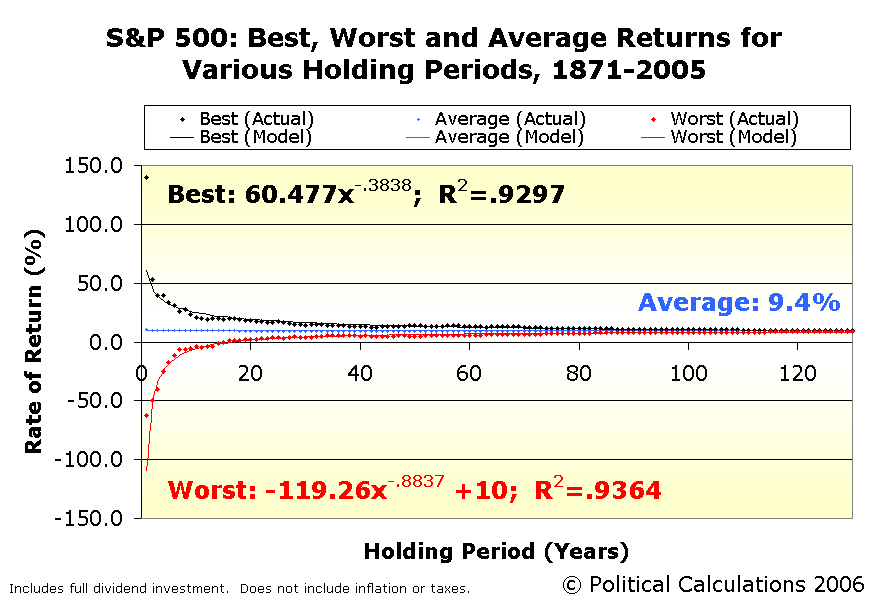
The rates of return presented above are annualized, and include full dividend re-investment that does not include commissions, fees, taxes or inflation. The points graphed are culled from the nominal returns for investments made in the S&P 500 index from 1871 through the end of 2005.
We find that in the historical data, the worst case nominal rate of return becomes positive for a 17-year holding period. Likewise, the worst case investment exceeds a 3.0% rate of return after 25 years and 5.0% after 36 years. These figures demonstrate the power of investing in a diversified pool of equities, as represented by the S&P 500 index, over long periods of time.
Where's the Tool?
Yes, we've developed a tool to do the math, but this post was long enough already! Look for it in days ahead here!...
Labels: best case, investing, SP 500, worst case


Welcome to the blogosphere's toolchest! Here, unlike other blogs dedicated to analyzing current events, we create easy-to-use, simple tools to do the math related to them so you can get in on the action too! If you would like to learn more about these tools, or if you would like to contribute ideas to develop for this blog, please e-mail us at:
ironman at politicalcalculations
Thanks in advance!
Closing values for previous trading day.
This site is primarily powered by:

CSS Validation

RSS Site Feed

JavaScript
The tools on this site are built using JavaScript. If you would like to learn more, one of the best free resources on the web is available at W3Schools.com.
Other Cool Resources
Blog Roll


